What is Ceramic?
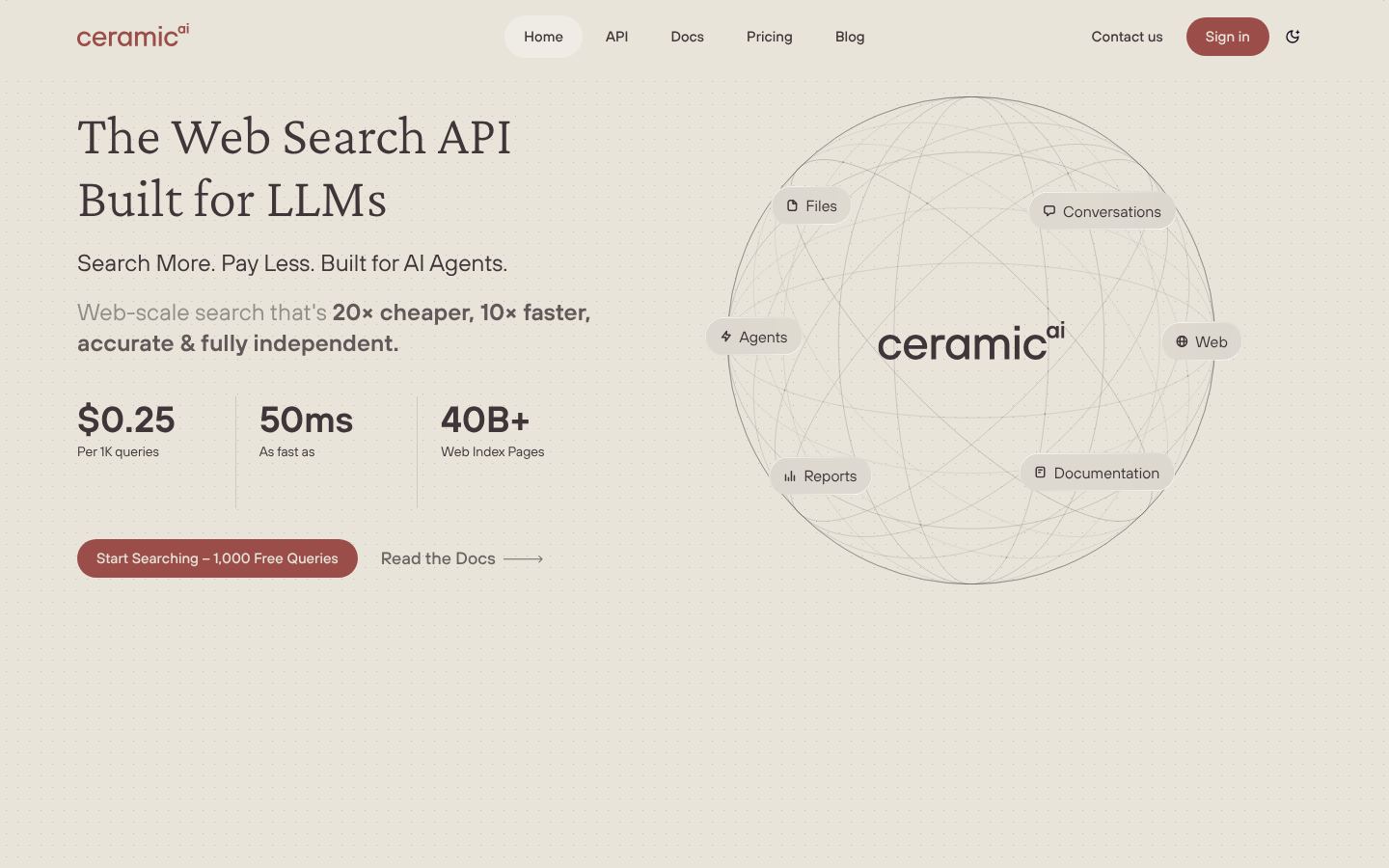
Ceramic is a keyword (lexical) web search API for LLM applications. It queries its own index, which the company puts at more than 40 billion pages, instead of reselling Google or Bing results. Each call returns up to 20 results with a title, URL, and a text excerpt of up to 8,000 characters, and the docs cover Python and TypeScript SDKs, an MCP server, and tool-use guides for LangChain, LlamaIndex, CrewAI, the OpenAI and Anthropic SDKs, and the Vercel AI SDK. Pay-as-you-go costs $0.25 per 1,000 queries after 1,000 free ones, at 20 queries per second; the $99 Pro plan includes 495,000 queries a month, bills extra usage at $0.20 per 1,000, and raises the ceiling to 50 QPS. Founder Anna Patterson was a VP of Engineering at Google, and the company raised a $12M NEA-led seed in March 2025, when it was still selling model-training infrastructure.
Our verdict
Price is the reason to look at Ceramic. On the Pro plan a million searches a month comes to about $200, cheap enough to run a lookup on every record instead of sampling. What you give up is scope and depth. The index covers English pages only for now. Matching is lexical, so the docs tell you to rewrite questions into keyword variants. And each result is an excerpt rather than the full page body, so anything that needs whole documents still needs a separate fetch step. The "20x cheaper" and index-size figures are Ceramic's own, and we have not seen them tested independently. Crawler trackers such as Dark Visitors list its crawler as TerraCotta, which is the user agent to look for if you write robots.txt rules for sites you run.
Categories:
AI extraction tools sit between a raw page and your database: you describe the fields you want, and a model returns structured JSON or LLM-ready markdown without hand-written selectors. They hold up well when page layouts change often, at the cost of per-request model spend and the occasional wrong field.