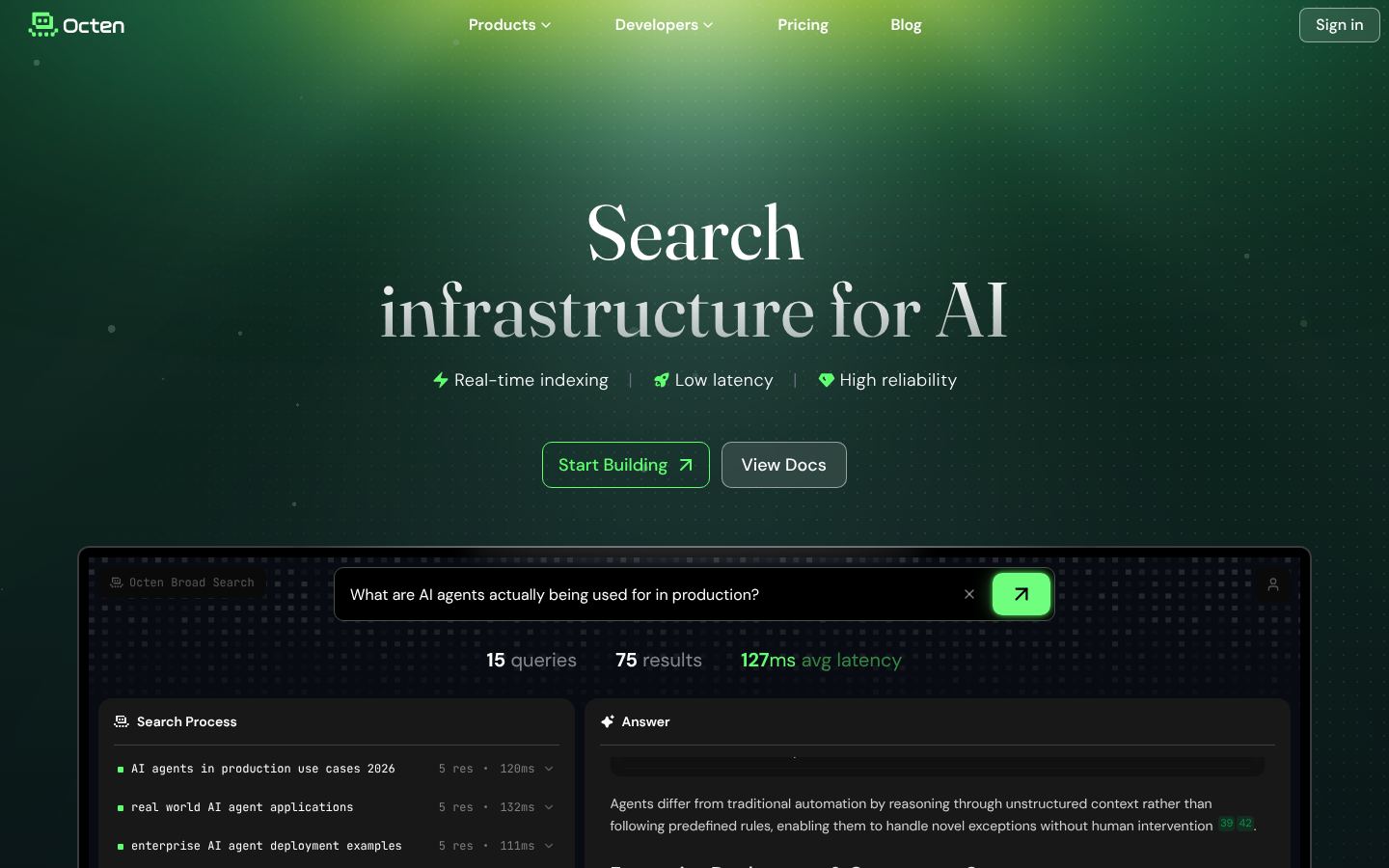
What is Octen?
Octen is a search and extraction API built for software agents rather than people typing queries. Pulse Search answers common lookups in roughly 10ms from $0.10 per 1,000 calls, Broad Search fans one request out into up to 30 concurrent sub-queries, and Extract handles up to 20 URLs per call and labels each page by type and category. News, business, place, image and video endpoints sit alongside text and vision-language embedding models. Founder and CEO Kuan Zou raised a $10M seed round led by Square Peg, reported in March 2026.
Our verdict
Octen is one of the few newer search APIs with an independent number attached. The Artificial Analysis Search Index scores it 77 against a top score of 80, and it is the fastest provider measured, at about 0.21 seconds per query, which matters when a collection job issues thousands of lookups. The billing is friendly to bulk work. Extract charges only for successful URLs ($1 per 1,000 standard, $2.50 advanced), and Broad Search bills per sub-query, so max_queries caps the spend on each call. Extract also tags pages with no main content, such as login walls and error pages, so you can drop them before they reach a model.
Pulse Search, added in late October 2026, cuts the cost of URL discovery at volume. It returns a URL and title at a median server-side latency of about 10ms for $0.10 per 1,000 calls, which is a tenth of the Web Search rate, because it answers from a generative retrieval model rather than a live index. Octen itself recommends Web Search for rare pages and for anything published recently, so Pulse is for resolving known entities to URLs rather than for finding fresh material. On 12 November 2026 Octen released the Pulse engine as open source with a technical report, and announced a $20 per month plan for individual developers with unlimited web search API calls, which had not appeared on its pricing page by that date.
For sustained throughput, the $1 per 1,000 Web Search rate is shown as 80% off a $5 list price, and anything above the free 20 QPS means a reserved plan from $2,099 a month, so cost out the high-volume case against list price before you commit.
Categories:
AI extraction tools sit between a raw page and your database: you describe the fields you want, and a model returns structured JSON or LLM-ready markdown without hand-written selectors. They hold up well when page layouts change often, at the cost of per-request model spend and the occasional wrong field.